Wednesday, May 23, 2007

Vertical Community

I went to the MoMa today, something I usually refuse to do because of the outrages price, but my step dad treated me. Anyway I saw this:

SITE (Sculpture in the Environment) and James Wines

I think it is amazing, I am considering talking to my boss about developing a project like this in New York. He won’t agree.

Wednesday, May 9, 2007

Remind Me


A kid sends his hand to the cookie jar without permission.
1. He gets slapped on his hand
2. He hears a loud NO
Why is it that when getting slapped the kid will remember better never to do it again? It seems as if our bodies remember much better then our minds (not that I am promoting child abuse or anything like that.)

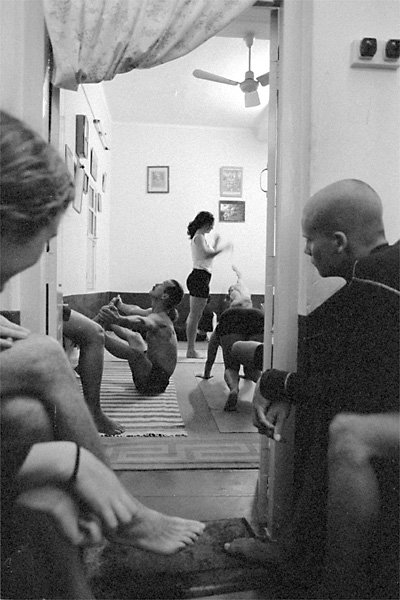
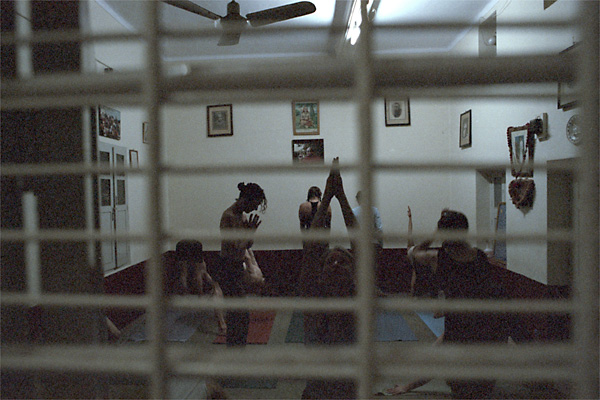
Every time I go back to the practice of Ashtanga Mysore Style I am in awe of how my body remembers what it used to know. The Vinyasa (sequence,) the Asana (poses,) and the feelings of pain and pleasure that flow through your body and mind.

These feelings and emotions will pass, you will be left with the merits of the practice.

Practice Mysore in NYC at The Shala, Yoga Sutra and Ashtanga Yoga New York

Photos from Alan Little’s Weblog


watching through the door


through the bars
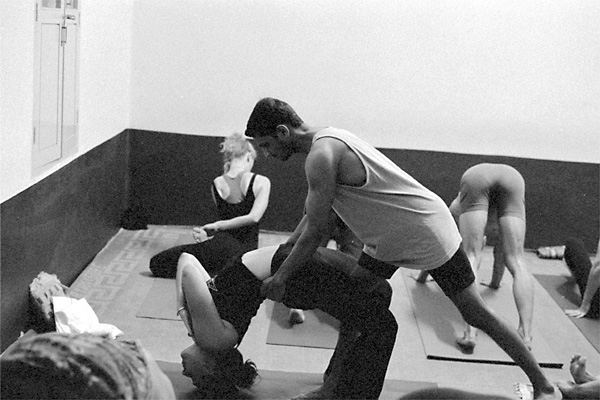

backbending

Tuesday, May 8, 2007

Streetlight people, living just to find emotion...

People say that New York City is a very lonely place.
I have mixed feelings about that statement. When I moved to NY I was very lonely, I found people very intimidating, strong, out of touch, and it made me feel lonely.

That feeling still comes back once in a while, like when I am at a party talking to someone, and someone else walks by (usually more attractive) and the person I was talking to just walks away. That makes me feel lonely.

At a party I attended this weekend there were a lot of very self confident, young and attractive people, I love that! Later on, there was a whole discussion among my friends about how intimidating “they” were. I don't love that! If you choose to see a group of individuals, which happen to be at the same place at the same time, as a UNIT, that is what you will get back from the universe, they will always see you a part of a group or classification.

Discrimination and being prejudiced are a result of this unattractive tendency. I know that might sound extreme but I really believe that you must maintain a sense of self, and also a sense of other’s self. If one thinks that by saying that someone belongs to a “group of really hot people” he is giving him respect, I disagree. Individuals deserve to be respected for what and who they are. If you don’t know who they are, let them be. You will get the same treatment from the universe when time comes.


Drg-darsana-saktyor ekatmatevasmita- Yoga Sutra II 6
The Yoga Sutra states that one of the Rout Affliction-Pain-Klesha is Asmita, or “I Am’nes” Identifying with your qualities, internal or external as what you ARE. If you look at people that way, how can you teach your own mind not to look at yourself in that way.

Only once you start detaching from that feeling of ego, and practicing “I Am That” or “I Am That I Am” you can feel in good company again. It is hard work, but who wants to be idle.

Thursday, April 19, 2007

Shavasana


My friends question was quit shocking to me; she wanted to know how to practice detachment from the death of her mother who died when she was 16 years old.
My immediate reaction was “What are you trying to detach from?”
Our teacher told us a story that remained me of this one:

There is a story told of a Zen master who is weeping after the death of his child. His disciple finds him weeping and says ,"But master, you have told us it’s all illusion."
“Yes," replies the master “And the death of one’s child is the most painful illusion of all."

I spoke with my friend after the class has ended. We spoke of ways of practicing detachment from the deep and evolved feeling and concept of death.

One of our teacher’s suggestions for practicing meditation was to start with a gross objects (he suggested a bottle of FIJI Water) and not subtle ones that are more of a concept like Love or Compassion. In the same mater I suggested practicing detachment on less conceptual subjects of death like Lost and Body.

Practice detachment from object that you feel very attached to, practice giving them up, leaving them behind, that is a first step to practice of detachment of loss.

Death of our body is related to the feelings of ownership that we have to our bodies, practicing detachment from that, from the vanity that we feel to our bodies, and our reactions to the immediate sensation of our bodies is the first step to the practice of detachment from our bodies.
The practice of Yoga (I use this here as the physical practice) is a great place to examine that feeling. As you move on and off your matt during your practice you will feel joy and pain. These feelings will pass, and you will be left with the results of your practice. The practice end with Shavasana or Corpse Pose, where we fully detach from our bodies.
Our bodies and mind learn that the sensation pass, and we are left with are benefits (which you should dedicate to the universe, but we can talk about that another time.)

So when you are practicing detachment, or anything else from a very subtle concept, that you find too large in magnitude to deal with, you may find these ideas helpful:
One, Choose a “grosser” subject to work on (instead of loss of life choose loss of objects); Two, choose a related subject for your intention (instead of loss of body in death choose sensation of the body.)

“Your practice will not free you from pain, which is part of human experience, but will free you from the suffering that grows out of grasping and clinging, out of wanting things to be different than they are. Your practice will give you the balance of wisdom and compassion, wisdom to see just how things are and compassion to keep your heart open with things as they are. I pause.”

Thursday, April 5, 2007

There are many forms of freedom


40 years in the desert is really quit a while. The classical theological explanation is that the generation that was liberated from Egypt was not worthy of entering the Holy Land. This year during the Seder we saw the separation of the Red Sea in the Epic movie The Ten Commandments; Moses offers a way out of Egypt and slavery, the Israelite find it hard to believe he will really get them out. In a close reading of the text it is evidence that they didn’t really want to leave Egypt. But why?

In the story of the Bhagavad Gita, Krishna places Arjuna’s carriage in the middle of the battle field opposite his Guru and Grandfather, and says to him, those you must kill in battle. Krishna could have positioned Arjuna opposite the villain making the decision to kill easy, but instead he chooses to have Arjuna face what he sees as himself, his grandfather who represents his family and thus his body, and his Guru, his spiritual being. You must kill what you BELIEVE TO BE your body and soul.

Christ’s body has to die for him to come back as the savoir, only when one has no body can he be the son of God. In the weeks before the death of Christ and his Resurrection, we take up Lent, where we forgo some of the pleasures of our daily life.

This week, also known as The Holy Week, I separated from one of my most favorite pleasures/attachments, FOOD. After two days of Juice fasting (it is what is sounds like) I took up eating only Raw food for a week. It also worked out great with Passover.

A while ago I went to hear Bob Thurman at Yoga Sutra NYC. Bob talked at some point about Love in India, he said that the meaning of the word LOVE in India is “wishing for the happiness of others.” Sometimes what we think is love, is really passions, then you don’t only wish for your partner’s happiness, but you are also attached, or maybe even try to posses. If that feeling is mutual, for a while you will both be in great possession of each others attachment, but naturally that will pass, and sometimes not in the same time which can then cause great agony and pain.

Krishna faces Arjuna’s carriage in front of Bhishma and Drona so that Arjuna recognizes that what he sees as himself is just an experience, an attachment. He must detach from that experience to be enlightened. The Israelites were so attached to their experience of slavery, that even the concept of freedom scared them. And that is why that generation was not worthy of entering The Holy Land.

There are many forms of slavery, but there are also many forms of freedom. Take this time of year to celebrate and find freedom. Like Arjuna, you first step must be to face them, recognize your attachments. When you find them, you need to separate from them for a while, like the 40 years in the desert, or just 4 days, you will know for yourself. Make sure you have an intention and when you succeed, which you will, take time to celebrate your success. Of course with no atachment…

"Do not store up for yourselves treasures on earth, where moth and rust consume and where thieves break in and steal; but store up for yourselves treasures in heaven, where neither moth nor rust consumes and where thieves do not break in and steal. For where your treasure is, there your heart will be also." Matthew 16-21